How Technology at Home Can Help Your Family Carer Worry Less While They’re at Work
Disclosure: This post contains affiliate links. If you make a purchase or sign up through one of these links, I may earn a small commission at no extra cost to you. I only link to products and services I consider genuinely useful. This does not influence my editorial content or recommendations.
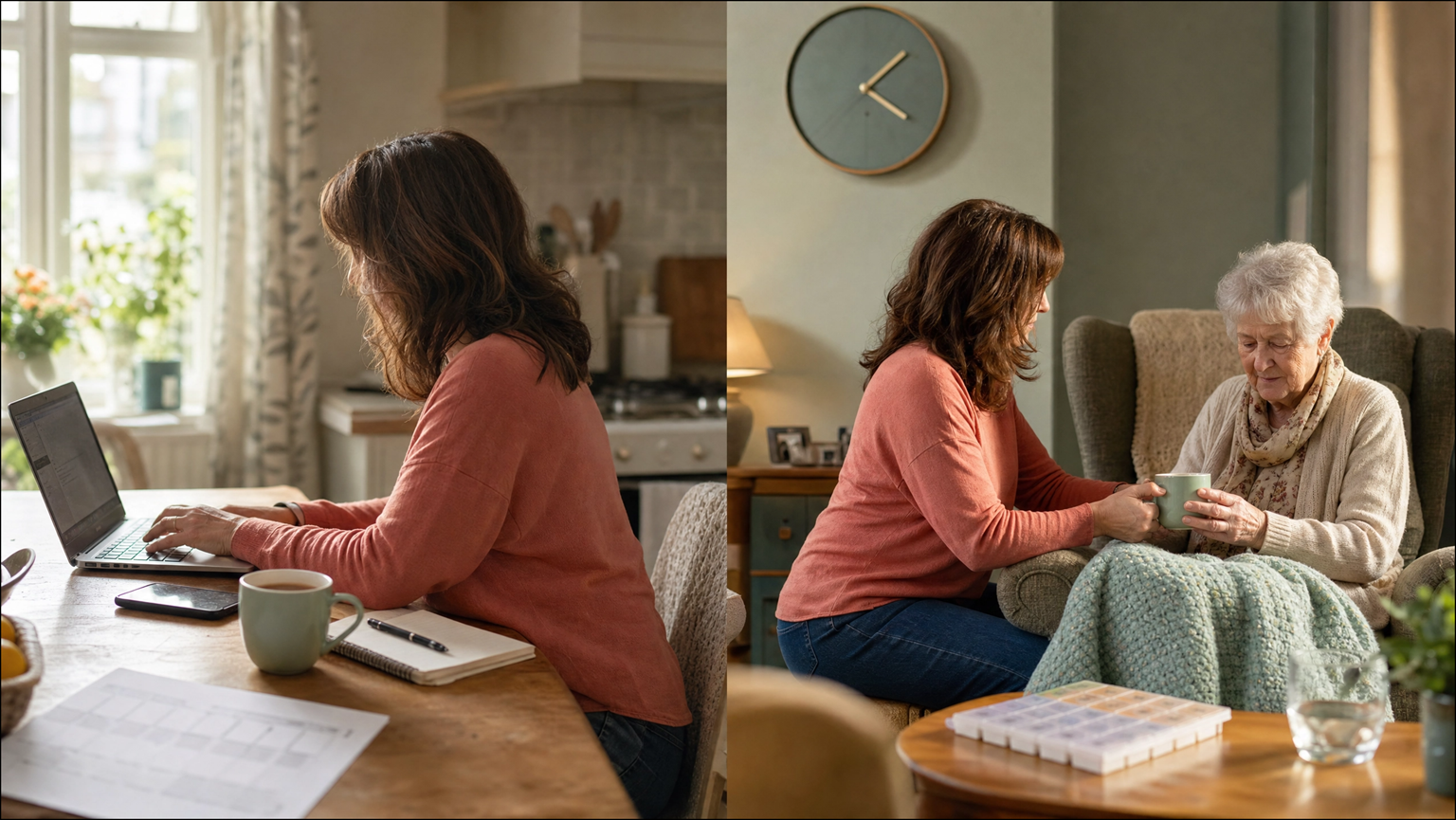
For older people and anyone who relies on a family member for support — if that person goes out to work as well as caring for you, this piece is for you. Small things you do at home can make a real difference to how they cope during the working day.
The key things to know:
- If your family carer goes out to work, they spend a significant part of their day worrying about whether you are safe, comfortable, and managing
- Simple technology — a community alarm, a medication reminder, a video doorbell — can significantly reduce that worry without reducing your independence
- Accepting help from technology is not the same as giving up your independence. In many cases it protects it.
- If your family carer also claims Carer’s Allowance, there are earnings rules they need to manage carefully — and there are ways you can support them in understanding this
- The most useful thing you can do is have an honest conversation with your carer about what would give them peace of mind
→ Find more guides for older people and their families — SeniorsLifeSafety
Want to understand the full picture?
Read on to understand what your working family carer is carrying, what technology can genuinely help with, and how a small change at home can make their working day significantly easier.
This is not about doing less or needing more. It is about making sure the person who looks after you is able to keep doing it.
If someone in your family goes out to work and also helps look after you, you may already have a sense of how much they are juggling. The early morning calls to check you are up. The worry about whether your medication has been taken. The mental load of managing two demanding roles at once — their job, and their caring responsibilities.
What you may not realise is how much of their working day is spent thinking about you. Not in a burden-like way — in a loving, anxious, I hope everything is all right way that runs quietly underneath everything they do between nine and five.
This piece is written for you, not for them. Because there are things that can genuinely help with that anxiety — things that keep you safer and more independent at home, and that give your carer a calmer, more sustainable working day. And some of those things are worth knowing about, whether or not you think you need them yet.
1. What your working carer is carrying during the day
Nearly 3 million people in the UK are currently combining paid employment with a caring role. Most of them do not talk about it at work. They manage their concern quietly — checking their phone between meetings, wondering whether to call, trying to judge whether to leave early or stay until five.
The worry is not usually about dramatic emergencies. It is the smaller, persistent things. Did they take their tablets? Have they eaten? What if they fell and couldn’t reach the phone? What if someone comes to the door and they’re not sure whether to answer it?
These thoughts take up real space in a working day. And the data shows what happens when that pressure accumulates without relief. According to Carers UK’s research, 600 people a day give up work to care entirely — not because they choose to, but because the mental load of holding down a job while worrying about someone at home eventually becomes unmanageable. Of those who stay in work, 69% say they have not been able to focus on their career as much as they would like, and 61% say caring has affected the type of job they have taken on — with one in five moving to a lower-paid or more junior role just to make the hours work.1
The personal cost is significant too. The GP Patient Survey 2025 found that 72% of carers have a physical or mental health condition expected to last 12 months or more — compared to 61% of non-carers — and that gap is growing year on year.2 Research for Carers Week 2025 found that 48% of current carers have seen their own health worsen since they began caring — and 40% have cancelled or postponed their own medical appointments because they could not find the time away from their caring responsibilities.3
Understanding this is the first step. The second is knowing that some of it can be reduced — not by your carer giving up their job, and not by you giving up your independence, but by putting a small number of practical things in place at home.
2. Accepting help from technology is not giving up independence — it is protecting it
Many older people are reluctant to accept assistive technology. The reasons are understandable. It can feel like an acknowledgement that things are not as they were. It can feel like surveillance. It can feel like the first step on a road towards losing control of your own home and daily life.
It is worth reframing this — and the evidence supports that reframing directly.
Falls are the leading cause of hospital admissions in older people in the UK, according to the NHS national clinical director for older people. More than one in three people over 65 fall at least once a year — and around one in five hip fractures is the primary reason a person moves into long-term care and loses the independence they had at home.4 A falls detection alarm worn as a pendant does not make a fall more likely. It makes the consequence of a fall less likely to be catastrophic — and it is precisely what allows many people to carry on living at home, independently, for longer than they otherwise could.
The community alarm you wear as a pendant is not a sign that you cannot cope — it is what allows you to carry on living at home, alone if you choose, with a safety net that means your family can worry less and therefore visit less frantically. The medication dispenser that beeps at the right time is not a sign that your memory is failing — it is what allows you to manage your own health without relying on someone else to remind you.
The technology in this context is not about dependency. It is about the conditions that make independence sustainable. A person living at home with a falls detection alarm is more independent than a person whose family insists on moving them somewhere with round-the-clock supervision because they could not bear the worry.
If you have been resistant to these things, it may be worth asking yourself: what is the cost of that resistance to the person who cares about you? Not as a guilt question — as a practical one. Because the answer often turns out to be significant.
3. The technology that makes the most practical difference
There is a great deal of assistive technology available, ranging from the simple to the complex. The things that tend to make the most meaningful difference to a working carer’s peace of mind are not necessarily the most expensive or elaborate. They are the ones that address the specific things a carer worries about most during the working day.
A community or personal alarm: Falls result in more than 250,000 hospital admissions among over-65s every year in the UK — and cost the NHS an estimated £2.3 billion annually, according to NHS data.4 A wearable alarm — worn as a pendant or wristband — that connects to a monitoring centre when pressed is still one of the most effective pieces of safety technology available. If you fall, feel unwell, or need help, you press the button and someone responds. Your family carer does not have to be the first point of contact. Many local councils offer community alarm schemes at low cost, and the peace of mind they provide to the carer during working hours is substantial. Ask your local council’s adult social care team what is available in your area.
A medication dispenser: Research commissioned by the University of Sheffield estimated that 237 million medication errors occur in England every year — with older people at particular risk because of multiple conditions and multiple prescriptions taken simultaneously.5 If you take regular medication, a dispenser that sounds an alarm at the right times and releases only the correct dose removes one of the most persistent sources of carer anxiety entirely. Models with phone alerts that notify a family member if a dose is missed are widely available from UK pharmacies and online suppliers. Some local authorities provide them through assistive technology schemes following an assessment.
A simple, reliable phone: If your current phone is difficult to use — too many functions, too small a screen, too quiet — a straightforward handset designed for ease of use can make a real difference. TTFone makes a range of mobile phones specifically designed for older and disabled users: large buttons, clear displays, loud volume, and on some models a dedicated SOS button that contacts a pre-set family member or emergency services. Being able to make and receive calls reliably is foundational. Everything else builds on it.
A video doorbell: If you find it difficult to get to the door quickly, or if you have ever felt uncertain about answering the door to someone unfamiliar, a video doorbell allows your family carer to see and speak to whoever is at your door from their phone — even while they are at work. This addresses two worries at once: the risk of you struggling to reach the door in time, and the risk of doorstep callers.
A smart speaker or voice assistant: Devices such as the Amazon Echo allow you to make calls, ask questions, set reminders, and contact family members entirely hands-free — no navigating a phone, no small buttons, no screen to manage. For people with limited mobility, poor eyesight, or conditions affecting dexterity, these devices can significantly extend the hours between visits and reduce the need for check-in calls during the working day.
A note on cost: many of these technologies are available at low or no cost through your local council following a needs assessment or a carer’s assessment for your family member. It is always worth asking what is available before purchasing anything privately.
4. If your family carer also claims Carer’s Allowance — this is important
If the family member who looks after you claims Carer’s Allowance, there is a rule about earnings that is worth both of you understanding — because it affects them in ways that can sometimes seem confusing or even hurtful from your perspective.
Carer’s Allowance has an earnings limit. In 2026/27, a carer who earns more than £204 per week after deductions loses the entire payment for that week — not just the amount they went over. There is no gradual reduction. It is a cliff edge.
What this means in practice is that your family carer may sometimes need to decline overtime, limit their hours in a particular week, or make decisions about work that seem cautious or unnecessary to you. It is not that they do not want to earn more. It is that going over the earnings limit — even by a small amount — wipes out the benefit entirely. The consequences of getting this wrong have been serious for a great many carers: by early 2025, nearly 144,000 carers had outstanding overpayment debts totalling around £251 million — a 71% rise in cases over six years — in many cases because they were not told about the overpayment until years after it had accumulated.6 An independent review published in November 2025 found that this was a systemic failure in how the rules were applied — not a failure by carers themselves. The DWP began reassessing over 200,000 cases from April 2026.
Understanding this helps in two ways. First, it means you can offer support rather than pressure when these decisions come up — knowing that a carer declining an extra shift is not laziness but financial management. Second, it means that if you pay someone to provide care while your family carer is at work — a home care worker, for example — those costs can reduce the amount counted as earnings for Carer’s Allowance purposes, which can give your carer more headroom.
For the family carer managing this week to week, CarersInfo has a free Threshold Checker tool and a plain-English guide: Juggling Work and Care: A Practical Guide for Working Carers in the UK — CarersInfo
And if they are concerned about their specific Carer’s Allowance position, they can check their earnings in under a minute using the free Threshold Checker at CarersInfo.
5. The conversation worth having
The most useful thing this guide can prompt is a conversation between you and your family carer — an honest one, about what they worry about during the working day, and what would help.
Many carers do not raise these concerns with the person they care for because they do not want to seem like they are complaining, or because they worry about making them feel like a burden. Many older people do not ask because they do not want to seem needy, or because they have not thought about the caring role from the carer’s perspective during work hours.
The question worth asking is simple: What would give you the most peace of mind while you are at work?
The answers are often practical and achievable. A specific alarm. A regular check-in call at a set time so the carer is not wondering all day. A medication system that removes the need to worry about tablets. Agreement to answer the phone when they call.
Small things. But the cumulative effect of those small things on a working carer’s day — and therefore on their ability to sustain the caring role long-term — can be considerable.
You are part of making this work
Your family carer is doing something genuinely difficult. They are holding down a job and looking after someone they love, often with very little support and very little recognition. The system does not make it easy for them.
You are not responsible for fixing that. But you are part of the picture — and small acts of understanding, practical openness, and willingness to try something new can make a real difference to someone who is trying very hard to be there for you without losing themselves in the process.
If one thing in this guide prompts a conversation, or leads to something being put in place that gives your carer an easier day, that is enough.
→ Find more guides for older people and their families — SeniorsLifeSafety
And for the family carer looking for practical support on the work and caring side:
→ Juggling Work and Care: A Practical Guide for Working Carers in the UK — CarersInfo
© SeniorsLifeSafety 2026. This post provides general information and is not a substitute for professional care, medical, or benefits advice. Statistics from Carers UK State of Caring 2025 and Key Facts and Figures, Carers Week 2025 Caring About Equality report, GP Patient Survey 2025 (NHS England), NHS/NICE falls guidelines (April 2025), University of Sheffield medication error research, and DWP/Sayce Review Carer’s Allowance overpayment data (November 2025). Technology recommendations are for general guidance only — individual needs vary and a needs assessment through your local council will identify what support you are entitled to. For Carer’s Allowance queries, contact the Carer’s Allowance Unit on 0800 731 0297 or Citizens Advice.
Sources
1. Carers UK. Key facts and figures. Carers UK (includes State of Caring 2025 employment data).
2. Carers UK (2025). The GP Patient Survey 2025: A widening health gap for unpaid carers. Carers UK press release.
3. Carers UK (June 2025). Nearly half of UK adults with caring responsibilities say their health has been impacted since caring. Carers Week 2025 research.
4. NICE (April 2025). New guideline will help cut falls and related hospital admissions for older and at-risk people. National Institute for Health and Care Excellence.
5. University of Sheffield / University of Manchester (2018). More than 200 million medication errors occur in NHS per year. University of Manchester News.
6. MoneySavingExpert (November 2025). Carer’s Allowance: 10,000s set to have outrageous overpayment debts wiped or reduced. MoneySavingExpert.com.
Affiliate disclosure: This post contains an affiliate link to TTFone. I may receive a commission if you make a purchase through this link. There is no additional cost to you. Affiliate relationships do not influence the information or recommendations in this post.